Why Binary Uses Two States to Represent Information
Why binary uses two states becomes clear when you compare number bases, switches and symbol codes, and see how long patterns carry useful information.
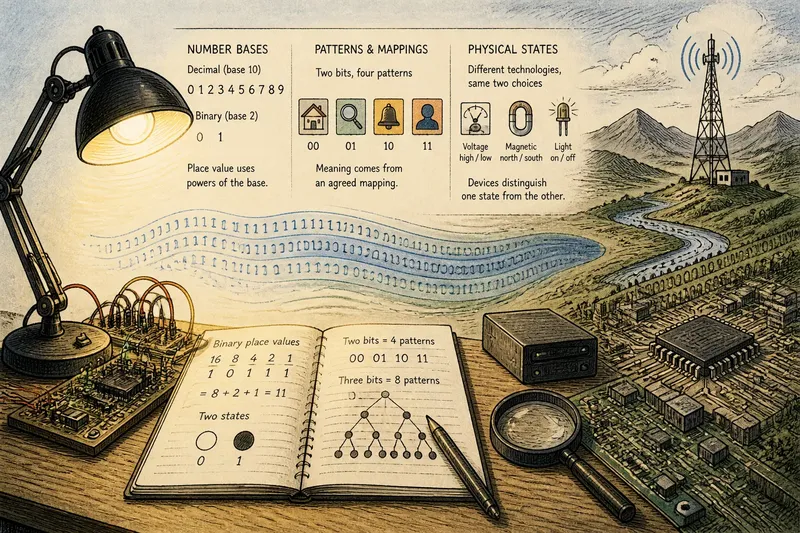
A desk lamp has two useful positions: on and off. That small choice is enough to make a binary digit, or bit, provided someone agrees which position means what. Why binary uses two states is not that information comes in pairs; it is that reliable distinctions can be arranged into patterns that represent far more than a lamp’s position.
Binary is one way of writing numbers, and bits are a way of storing or transmitting distinctions. Those ideas are related, but not identical. Comparing binary with familiar decimal notation, and with the physical states used by computers, helps explain what the two-state system offers and when its longer patterns are worth the trouble.
Three useful viewpoints
There are three sensible ways to look at binary: as a number base, as a pattern of symbols, or as a choice of physical states. Each answers a different question. Number bases explain how place value works. Symbol patterns explain how bits can stand for many kinds of information. Physical states explain how a device can keep or communicate those bits.
For everyday arithmetic, decimal is usually the convenient choice. For understanding digital representation, binary is the essential one. For building or diagnosing a system, the physical implementation matters too, although a user rarely needs to know its engineering details.
Decimal and binary
Decimal uses ten digit symbols, from 0 to 9. Its place-value rule assigns each position a power of ten. In the decimal number 472, the 4 means four hundreds, the 7 means seven tens, and the 2 means two ones.
Binary uses two symbols, conventionally written 0 and 1, and each position represents a power of two. Read from right to left, the positions are worth 1, 2, 4, 8 and so on. The binary pattern 1011 therefore means eight plus two plus one, or eleven in decimal.
This is not a different kind of quantity. It is the same quantity written with a different set of place values. A calculator may display a value in decimal because people can read it readily, while a computer’s internal circuits work with patterns that can be interpreted as binary.
Decimal suits people doing ordinary counting and calculation. Binary suits a machine’s representation of information when its underlying components distinguish two states. A reader learning computing benefits from being able to translate simple patterns, rather than treating binary strings as mysterious machine language.
When a binary string looks long, group its positions by their place values instead of trying to read it as a sequence of spoken digits.
Bits and longer patterns
A single bit has two possible values. Add another bit, and each earlier choice can be paired with either value of the new one. Two bits can form 00, 01, 10 or 11. Three bits make eight patterns; each added bit doubles the number of available patterns.
The important point is not that every pattern has a natural meaning. A pattern gains meaning through an agreed mapping. If a system assigns 000 to one letter and 001 to another, those strings can represent text. A different mapping could assign them to colours, sound samples, instructions or numbers.
Say a small display needs to choose among four icons: a house, a magnifying glass, a bell and a profile. Imagine assigning each icon one of the patterns 00, 01, 10 and 11. A stored pattern of 10 then selects the bell only because the display’s design says so; without that shared mapping, it is merely two bits.
This is how a small alphabet of states can support a much larger vocabulary. The pattern length sets how many distinct arrangements are available, while the interpretation rules decide what those arrangements mean. Longer patterns can represent more choices, but they also require more positions to store, send or process.
States in hardware
A bit is an abstract value, not a tiny object labelled zero or one. In a computer, the values are represented using physical differences that a device can distinguish. Depending on the technology, those differences may involve electrical conditions, magnetic orientation or another property.
Designers choose two-state representations because a system needs dependable ways to tell one value from another. Physical conditions are not perfectly tidy: signals can vary, components can be noisy, and readings must be interpreted. A system can define ranges of conditions as the two intended states, leaving some room for ordinary variation.
That does not make every device identical, or mean that the physical state is literally a zero or a one. The labels describe the logical values used by the system. The particular mechanism is an implementation choice, rather like using ink or pencil to write the same number.
For a learner, it is usually more useful to distinguish the logical bit from the hardware that represents it. For someone choosing or maintaining equipment, the implementation matters when it affects compatibility, durability or the way data is retained. Those are device-specific questions, not properties of binary notation itself.
Why two-state design?
Two-state systems offer a comparatively clear distinction: this value or that one. A device can be designed to recognise those alternatives despite some variation in the physical signal. That simplicity is useful when components must repeatedly store, copy and interpret patterns.
A system could use more than two distinct states. In principle, a symbol with more possible values can carry more information per position. But the system then has to distinguish those values reliably and agree how each one is represented. The engineering trade-off depends on the components and conditions involved; two states are a practical foundation, not a law of nature.
Longer binary patterns also have costs. They take more positions than a notation with a larger symbol set might need for the same number of alternatives. Yet binary’s regular place values and clear two-way distinctions make it broadly useful across digital systems. The simplicity is at the level of each position, not necessarily in the length of the complete representation.
Which view suits you?
The best starting point depends on the question you are trying to answer. Use these distinctions to choose a useful level of detail:
- Choose decimal-to-binary conversion if you want to understand how a number is written in another base. Work through the place values and check that their sum matches the decimal quantity.
- Choose bit patterns and mappings if you want to understand how numbers, characters or icons can be encoded. Ask what each pattern stands for in the system you are looking at.
- Choose the physical-state view if you want to understand how a device stores or reads information. Focus on the distinction the hardware must recognise, rather than assuming every bit is a literal switch.
These views fit together, but one need not begin with all three. A student studying number systems can start with place value. Someone reading about text encoding should look for the mapping between patterns and characters. A person curious about hardware can then ask how a component makes the abstract distinction physically reliable.
Questions about binary?
Does binary only represent numbers?
No. Binary patterns can represent numbers, text, colours, sound and instructions when a system defines a mapping for them. A bit string on its own does not say which kind of information it represents.
Why are the symbols 0 and 1?
They are convenient labels for the two logical values. A device’s physical states need not look like written zeroes and ones; the notation lets people reason about the states consistently.
Can a bit have more than two values?
By definition, a bit has two possible values. Other systems can use units with more than two possible states, but those are not single bits in the usual sense and need their own representation rules.
Why do binary strings get long?
Each position offers only two choices, so representing many distinct possibilities can require many positions. The benefit is that the same simple two-value structure can be repeated and interpreted by digital systems.
Read the pattern
Why binary uses two states is easiest to remember as a sequence of decisions: a system distinguishes two values, combines those choices into longer patterns, then applies a mapping to interpret the result. The physical states support the distinction; the code supplies the meaning.
When you meet a string of zeroes and ones, ask two separate questions: what quantity or choice could this pattern encode, and what rules tell this particular system how to read it? Keeping those questions apart makes binary less like secret writing and more like an ordinary notation with unusually small symbols.